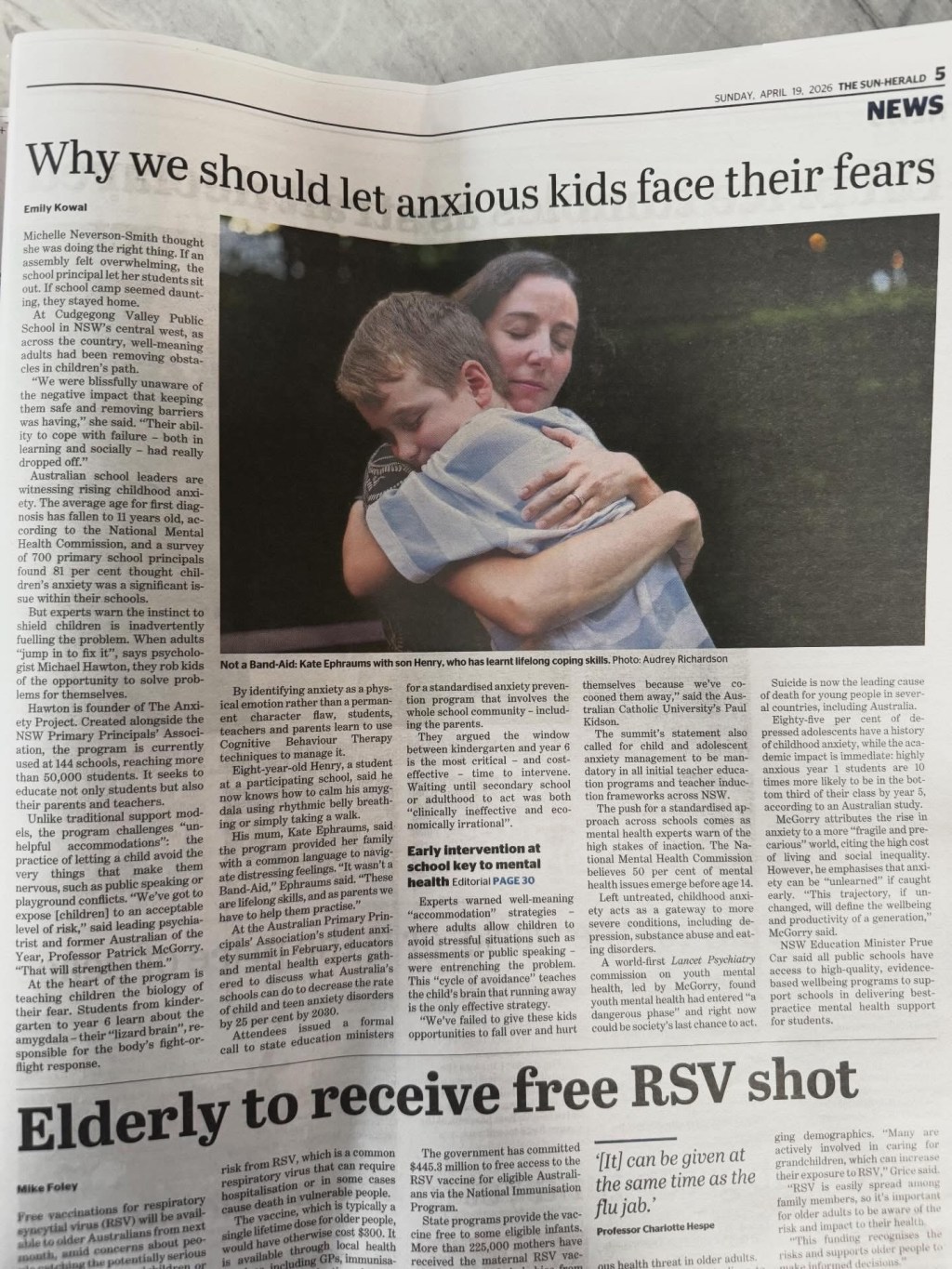
Our Beyond Outdoor Learning program recommences for its sixth year this week, and as staff plan for another season of rich, engaging lessons, it has been both affirming and timely to read the recent Sun Herald article, “Why we should let anxious kids face their fears”(Emily Kowal, April 2026). The stories, data and warnings in the article closely mirror what many schools – including our own – have been observing firsthand.
The article opens with a confronting reflection from a school principal who realised that, despite good intentions, repeatedly removing challenge from students’ lives had come at a cost. Allowing students to sit out of assemblies, avoid camp, or step away from experiences that felt overwhelming seemed kind and protective at the time. But the impact was sobering: “Their ability to cope with failure – both in learning and socially – had really dropped off.”
Across Australia, school leaders are reporting rising childhood anxiety. The article cites National Mental Health Commission data showing the average age of first diagnosis has fallen to just 11, with 81 per cent of surveyed primary principals identifying anxiety as a significant issue within their schools. Experts warn that the instinct to shield children from discomfort, though well intentioned, is unintentionally fuelling the very problem adults are trying to prevent.
Psychologist Michael Hawton, founder of The Anxiety Project, names the risk clearly: when adults continually “jump in to fix it”, children are robbed of the opportunity to solve problems for themselves. Over time, avoidance becomes the strategy the brain learns best. As the article explains, this “cycle of avoidance” teaches children that running away from discomfort is the safest option – even when the situation is manageable.
Leading psychiatrist and former Australian of the Year Professor Patrick McGorry is quoted bluntly, children need exposure to “an acceptable level of risk” in order to strengthen. Without it, resilience does not develop.
This is exactly where Beyond Outdoor Learning sits.
Beyond Outdoor Learning is our intentional, school wide response to this research and reality. The program does not eliminate challenge – it designs for it, carefully and responsibly. Students engage with real tools, real responsibility, real uncertainty and real consequences.
Effective anxiety prevention is not about throwing children into distress, but about early, repeated, supported exposure to challenge. This is why Beyond sessions follow a predictable learning cycle. Grounding and mindfulness come first. Skills are explicitly front loaded. Adults coach rather than rescue. Reflection is built in. Students are never left alone with risk – but they are also not shielded from it.
Fires do not light the first time. Knots slip. Shelters collapse. Frustration rises. Emotions surface. And adults resist the urge to smooth the path. As one parent quoted in the article reflects about an effective intervention, “It wasn’t a Band Aid… These are lifelong skills, and as parents we have to help them practise.”
Beyond Outdoor Learning creates exactly this kind of practice space.
The article also highlights that anxiety is a physical response, not a character flaw – rooted in the amygdala, the brain’s fight or flight centre. Children learn that fear is something that can be understood, regulated and managed, rather than avoided. This aligns directly with Beyond’s emphasis on emotional literacy, self regulation and reflective practice.
The stakes are high. Fifty per cent of mental health conditions emerge before the age of 14. Untreated childhood anxiety is linked to later depression, disengagement and reduced academic outcomes. But there is hope: anxiety can be unlearned – particularly when intervention happens early, consistently and in community.
By learning to tolerate frustration, uncertainty and effort outdoors, students develop the emotional muscle required for learning everywhere else. Teachers consistently observe that students return from Beyond Outdoor Learning calmer, more focused and more willing to persist. Children who learn that they can cope with discomfort outdoors are more willing to take intellectual risks in the classroom.
The impact is often quiet but profound: students who persist longer, regulate more effectively, collaborate more generously, and approach learning with growing confidence. As the national conversation now makes clear, wellbeing does not come from removing challenge. It comes from teaching children how to face it.
This is why we take learning beyond the classroom – and why we will keep doing so.


Leave a Reply