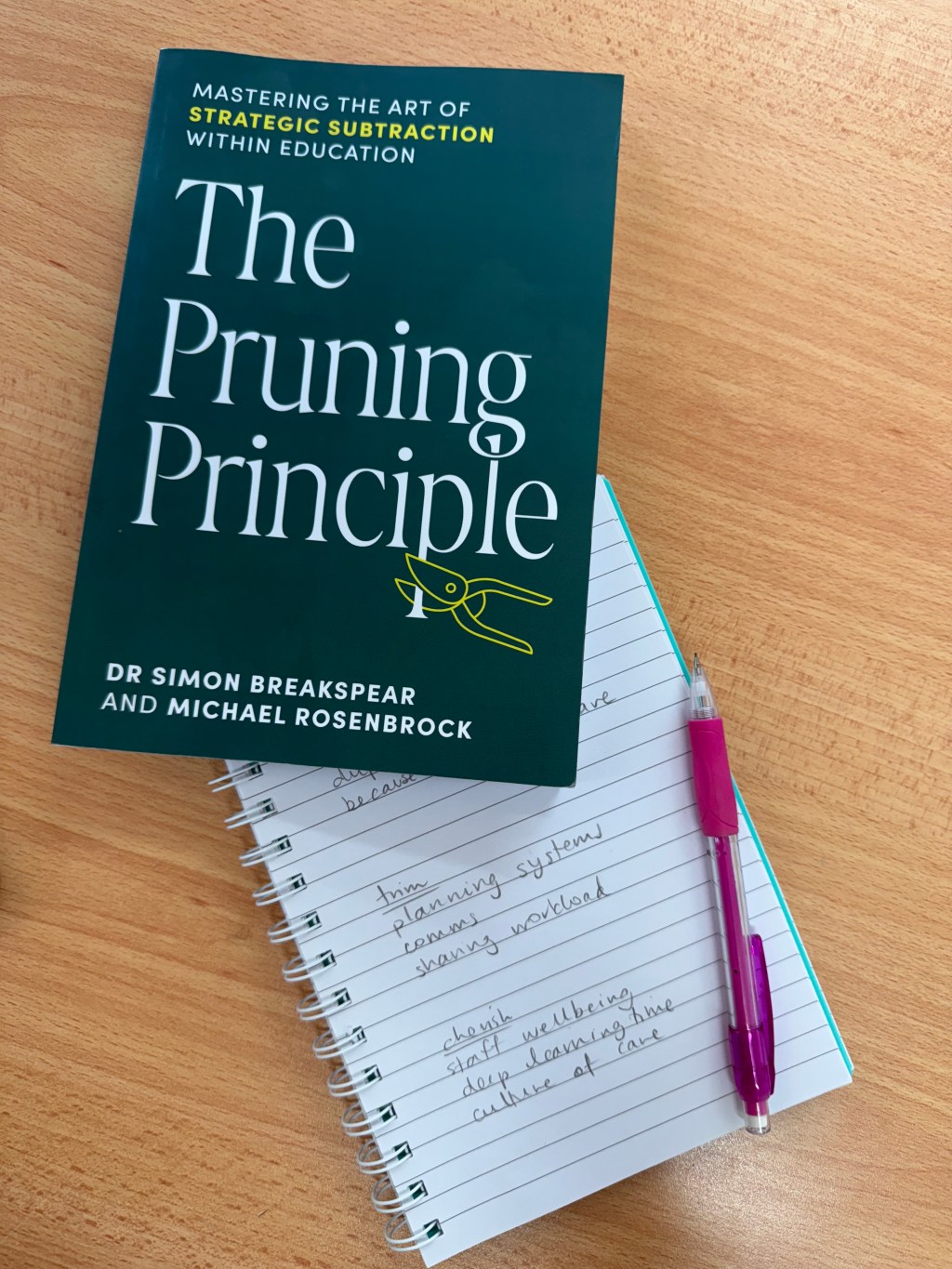
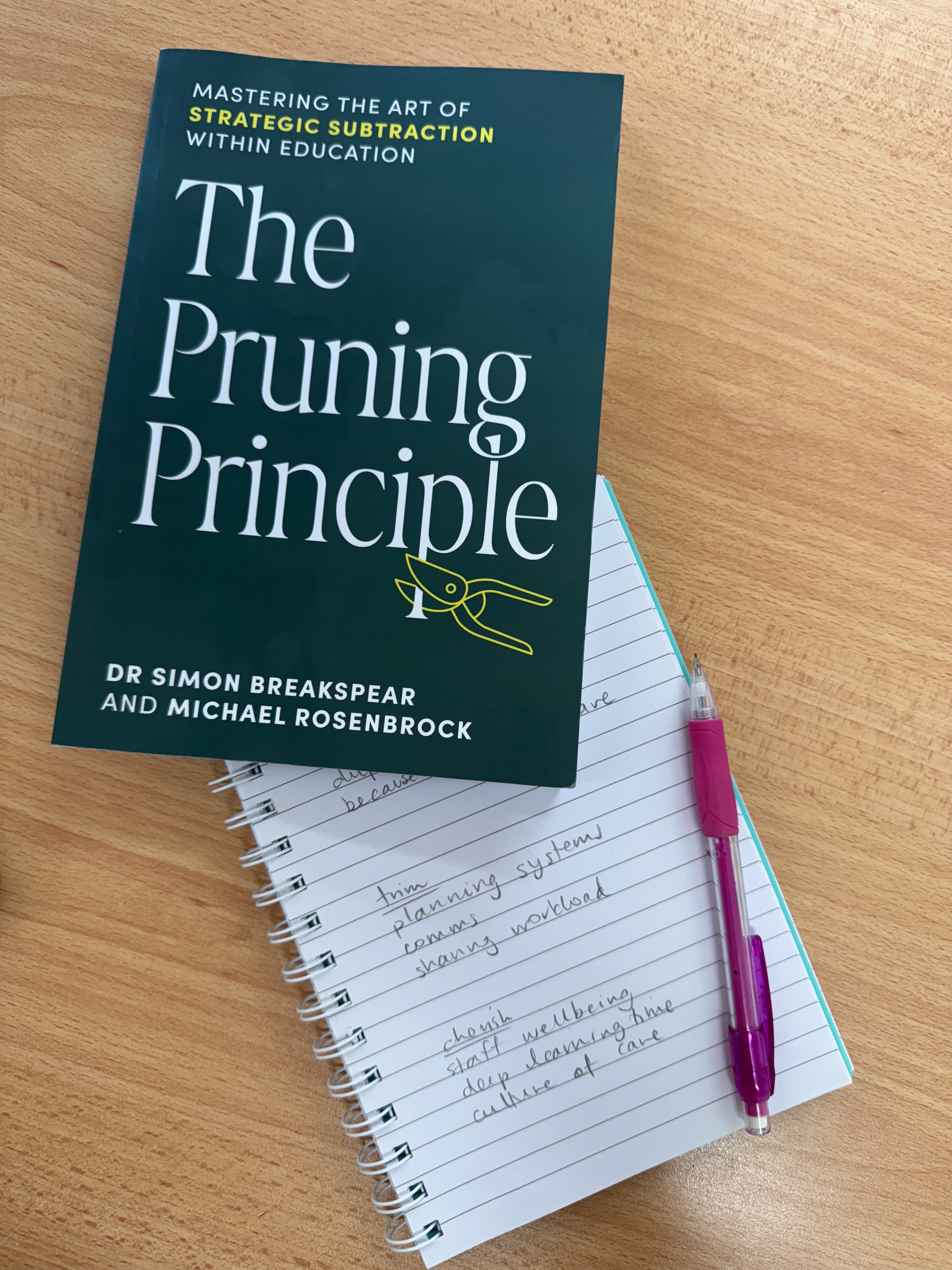
A review of ‘The Pruning Principle’, by Dr Simon Breakspear & Michael Rosenbrock
I’ve always prided myself on being efficient. One of the mantras I picked up early in my career from my former Principal Eloise Beveridge was “do it now.” If you’ve got a minute, send the email, make the call, tick the task off. That habit has kept me afloat through many seasons of leadership, and for a long time, it worked beautifully. But lately, I’ve felt its limits.
During my time at Lobethal Lutheran, our enrolments have almost doubled. It’s a milestone we’re proud of, a sign that families trust what we’re building. But with that growth has come a new kind of pressure. More students mean more needs. More communication. More logistics. More of everything. And in a small school, where everyone already wears multiple hats, that “more” can slide from stretching to overwhelming in no time.
When our business manager handed me a copy of The Pruning Principle by Simon Breakspear and Michael Rosenbrock, I didn’t expect it to strike such a chord. I was grateful, always open to a good leadership read, but also a little sceptical. After all, we’re a small school. We run lean. There’s no fat to cut.
But as I began reading, I quickly realised this wasn’t a book about trimming excess. It was about something far more pertinent – leading with clarity in the midst of complexity. It was about making space for what matters most, even when everything feels essential. And it was exactly what I needed.
On the very first read, a line stopped me:
“Pruning isn’t about less for less’ sake. It’s about creating the conditions for what matters most to flourish.”Rather than being challenged to cut harder, I was being asked to think differently.
One of the book’s central ideas is that pruning isn’t about doing less for the sake of it. It’s about doing less so we can do what matters better. Subtraction, not retreat. That idea has stayed with me.
The authors outline a three-phase cycle – Critically Examine. Consciously Remove. Carefully Nurture.
This approach has helped me notice things differently, questioning long standing routines and wondering whether some of our “must-dos” are still serving our community as well as we think. As the book puts it,“Not everything that was valuable once is valuable forever.”
Subtraction as a Strategy
The book reframed subtraction for me, not as retreat, but as leadership courage. “To subtract well,” the authors write, “is to lead with clarity, even when everything feels essential.”
That line has stayed with me. At Lobethal, I’ve started noticing duplication. Where communication could be sharper. Where trust could free us to delegate more deeply. These aren’t grand reforms. They’re seeds. But as the authors remind us, “Small acts of subtraction compound over time.”
Energy, Not Branches
Perhaps the most powerful metaphor in the book is this: “Even in lean systems, pruning is possible not by cutting branches, but by reshaping how energy flows.” The challenge isn’t to trim harder, but to redirect energy.
What would it look like to free staff from the low value time hungry tasks that creep into our week?
What would it look like to consciously guard time for creative, generative work, the kind that gives life rather than drains it? One practical suggestion from the book is to design “clarity windows”, periods in the week where meetings and interruptions are off limits, and leaders and teachers can focus deeply.
A Shared Practice
Another insight that struck me is that pruning isn’t meant to be a solitary act. “Clarity is cultivated in community,” the authors say. That changes everything. Too often, pruning feels like the lonely responsibility of a leader, the one who has to “cut.” But what if we made it a cultural practice?
I imagine sitting with staff and asking simple but profound questions, What’s draining us? What’s giving us life? What must we protect at all costs?
I can already sense how naming those things aloud could renew energy and build ownership.
This will be a goal for us in Week 0 of 2026, using the structure of the principle as a guide.
Courage Looks Like Letting Go
The line I’ve returned to most is this, “To lead with clarity is to lead with courage. And courage often looks like letting go.” Letting go of tasks that no longer serve, habits that once made sense but now consume more than they give, and the illusion that doing more is always better.
Clarity isn’t stumbled upon it’s cultivated, patiently and intentionally. That’s what The Pruning Principle offered me. Not a checklist, rather a mindset. A way of leading that places purpose above pressure.
 FromtheForest
Leave a comment